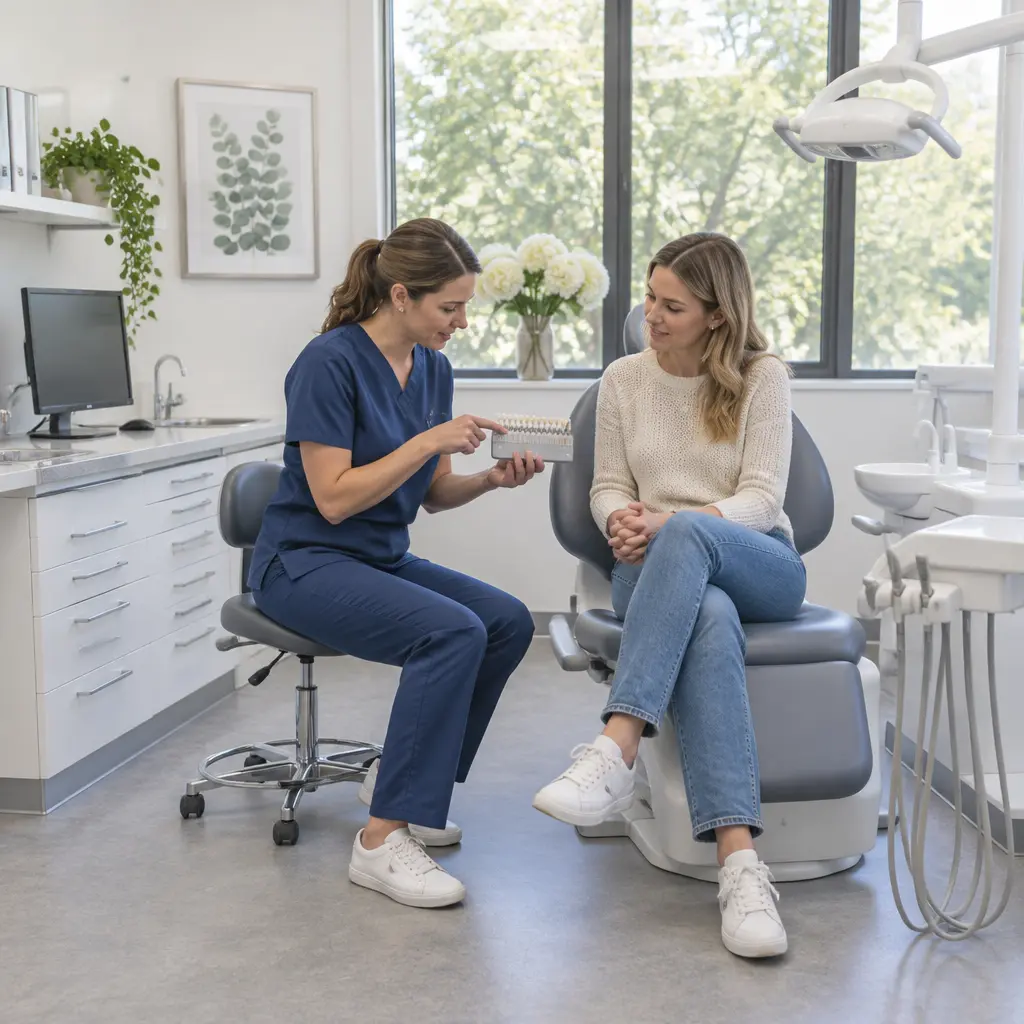
Professional vs. home teeth whitening is best compared by the amount of verified color change per dollar—not by product price alone. “Cost per shade” divides the total treatment cost by the number of shades of improvement on a standardized dental shade guide. In-office treatment can produce a faster, supervised result, while home options—from dentist-dispensed trays to over-the-counter strips—usually cost less upfront but require repeated use. Because shade results vary by stain type, starting color, product, and measurement method, published research does not support one dependable universal price per shade. The practical approach is to compare total costs, realistic outcomes, treatment time, and safety, while treating advertised shade claims cautiously.
Cost per shade defines how professional and home whitening value is measured
Cost per shade is a comparison metric: total whitening expense divided by the measured shade improvement. For example, a $500 treatment that improves tooth color by five shade-guide units has a calculated cost of $100 per unit. This arithmetic is straightforward; the difficult part is ensuring that the cost and improvement are measured consistently.
The American Dental Association (ADA) describes tooth whitening as treatment that lightens teeth and helps remove discoloration. It distinguishes dentist-supervised approaches, including in-office bleaching and dentist-dispensed take-home products, from non-prescription whitening products. These categories matter because they differ in concentration, delivery, professional oversight, treatment time, and price.
A “shade” is not a universally standardized unit of clinical improvement. Dental shade guides use ordered tabs, but guides and measurement conditions can differ. Lighting, tooth hydration, examiner judgment, and the guide selected may affect a reading. Consequently, a cost-per-shade calculation is most useful when the before-and-after assessments use the same guide and conditions; it should not be treated as a guarantee of a particular result.
The calculation requires total cost and measured change
Use this formula: cost per shade unit = total treatment cost ÷ observed shade-guide units improved. Include the costs that are relevant to the comparison, such as consultation, custom trays, replacement gel, follow-up visits, and maintenance. State whether the calculation covers the initial treatment only or a longer period.
Illustrative example: if a treatment costs $400 and a dentist records a four-unit improvement on the same shade guide, the arithmetic result is $100 per guide unit. This example demonstrates the method; it is not a typical outcome, price quote, or prediction. If the shade change is not measured consistently, the number can imply more precision than the evidence supports.
Shade improvement is not the same as perceived whiteness
Shade-guide movement measures a change in color category, while perceived whiteness is influenced by lighting, tooth shape, surrounding restorations, and personal expectations. A small recorded change may look noticeable to one person and subtle to another. The ADA notes that crowns, veneers, fillings, and other restorations do not whiten like natural teeth, so uneven color can remain even when natural teeth lighten.
Professional whitening trades higher cost for supervision and controlled delivery
Professional whitening includes in-office bleaching and dentist-dispensed take-home systems. Its defining attribute is not simply a stronger product: it is treatment planned or provided with dental oversight. The dentist can assess oral health, discuss likely outcomes, and help manage sensitivity or soft-tissue irritation.
Professional results still vary. A 2018 systematic review and meta-analysis by de Geus and colleagues compared in-office and at-home bleaching and found that both approaches can whiten teeth; the review did not establish that one method is universally superior in effectiveness or sensitivity. Differences among studies—including bleaching agents, concentrations, protocols, and outcome measures—make direct cost-per-shade comparisons difficult.
In-office bleaching prioritizes speed and clinical oversight
In-office bleaching applies a dentist-selected whitening agent during a scheduled appointment, sometimes over more than one visit. The main practical advantage is speed: treatment is delivered in a controlled setting rather than spread across many home applications. The total price can include the appointment and examination, and varies by location, provider, product, and number of visits.
A high upfront price does not automatically mean a poor cost per shade, just as a quick result does not guarantee a large or lasting shade change. Ask the dental office what costs are included, how improvement will be assessed, whether a follow-up is expected, and what maintenance may cost. Sensitivity and temporary gum irritation are recognized potential side effects of bleaching, according to the ADA.
Dentist-dispensed take-home trays balance customization and time
A dentist-dispensed home system commonly uses custom trays and prescribed or supplied whitening gel. It is a professional option used at home, not the same category as an uncustomized retail kit. The custom fit can help keep gel in contact with teeth and limit contact with gums, while the user completes applications over a planned period.
For cost comparisons, count the dental assessment, trays, gel, and any replacement supplies or monitoring. The approach may be suitable for people who prefer gradual treatment, but completion depends on following instructions. Ask the dentist whether existing restorations will create a color mismatch and how to respond if sensitivity occurs.
Home whitening lowers the entry price but varies by product and adherence
Home whitening covers non-prescription strips, gels, rinses, toothpastes, and tray kits. These options usually have a lower initial purchase price than a dental-office visit, but products differ substantially in active ingredients, contact time, application method, and evidence. Their cost per shade cannot be inferred from retail price or packaging claims alone.
The ADA’s consumer guidance advises checking for the ADA Seal of Acceptance, which indicates that a product has met the organization’s safety and effectiveness requirements for its stated claims. The ADA also advises consulting a dentist before whitening when a person has untreated cavities, gum disease, or other oral-health concerns. The seal is not a promise of a specific shade change for every user.
Whitening strips and gels are judged by actual use and outcomes
Strips and gels place a whitening agent on tooth surfaces for a specified duration and schedule. They can be relatively inexpensive to try, but their value depends on the product, correct use, and whether the discoloration responds to bleaching. Compare the full course price with a measured result rather than comparing one package’s price with a professional treatment’s total bill.
Peroxide-based whitening can cause temporary tooth sensitivity and gum irritation. Using more product, applying it longer, or repeating courses more often than directed does not establish a better value and may increase the risk of discomfort. Follow the product label and seek dental advice if symptoms are significant or persistent.
Whitening toothpastes mainly address surface stains
Whitening toothpastes generally rely on abrasives or other ingredients to help remove surface stains; they should not be assumed to produce the same kind of color change as peroxide bleaching. Their comparatively low ongoing cost may make them useful for stain management, but a “cost per shade” calculation is often unsuitable unless a measurable shade change is demonstrated over a defined period.
The distinction is important for consumers whose discoloration is intrinsic—originating within the tooth—or related to trauma, medication, or dental development. The ADA explains that whitening treatments may not respond uniformly to different causes of discoloration. A dental examination can help identify whether bleaching is likely to address the concern.
A fair professional-versus-home comparison controls the main variables
A useful comparison records the same kinds of information for every method: out-of-pocket cost, treatment duration, shade-measurement method, number of applications or visits, sensitivity, and maintenance. It also separates dentist-dispensed take-home treatment from over-the-counter products instead of grouping every home method together.
Use a like-for-like comparison table
The table below is a framework, not a price survey. Actual costs and shade changes vary by provider, product, market, and individual. Fill in local quotes and documented outcomes before drawing a value conclusion.
| Method | Costs to include | Outcome to record | Key comparison issue |
|---|---|---|---|
| In-office bleaching | Examination, appointment, additional visits, maintenance | Before-and-after shade reading on the same guide | Higher upfront cost; treatment delivered under clinical supervision |
| Dentist-dispensed take-home trays | Assessment, trays, gel, refills, follow-up | Shade change after the prescribed course | Treatment time and adherence affect the comparison |
| Over-the-counter strips or kits | Complete course, repeat purchases, any dental consultation | Measured change after label-directed use | Products and active ingredients differ |
| Whitening toothpaste | Ongoing purchase cost over the comparison period | Surface-stain change, if measurable | Not a direct substitute for bleaching |
Calculate both treatment-only and maintenance cost
A first-course cost-per-shade figure answers a narrow question: how much did the initial course cost for the recorded improvement? A longer-term comparison should also include repeat courses or maintenance over a stated period. Do not assume that a result lasts for a fixed duration: diet, tobacco use, oral hygiene, and individual factors can influence the return of staining.
For a transparent report, show the calculation and its assumptions. For instance: “Treatment cost: $X; measured improvement: Y guide units; initial cost per unit: $X divided by Y; measurement date: Z; maintenance excluded.” If the outcome is not measured, label the result as an estimate rather than presenting it as an observed cost per shade.
Safety and stain type can outweigh a low calculated cost
The least expensive option is not necessarily the best-value or appropriate option. Whitening does not correct every cause of tooth discoloration, and bleaching can produce sensitivity or gum irritation. Dental evaluation is especially relevant when discoloration affects one tooth, follows an injury, or occurs alongside pain, cavities, or gum problems.
Restorations—including crowns, veneers, and fillings—do not whiten in the same way as natural teeth. The ADA notes that treatment may therefore leave a mismatch between natural teeth and existing dental work. Discuss this possibility before bleaching, particularly when restorations are visible in the smile.
The U.S. Food and Drug Administration regulates products according to their intended use and applicable product category; its consumer information cautions people to use dental products as directed. Avoid unverified whitening remedies and do not exceed package or dentist instructions. A low advertised price cannot compensate for uncertain ingredients, an unsuitable treatment, or avoidable harm.
Conclusion: compare measured improvement, full cost, and suitability
Cost per shade is a helpful but limited way to compare professional and home whitening. In-office treatment offers speed and clinical oversight; dentist-dispensed trays combine professional planning with at-home use; over-the-counter products can reduce upfront expense but vary in formulation and results. Toothpastes mainly address surface staining and are not directly comparable to bleaching.
For a meaningful decision, request a complete cost estimate, identify the likely cause of discoloration, and compare outcomes measured with the same shade guide under similar conditions. Include maintenance when evaluating longer-term value, and ask a dentist about restorations, sensitivity, and oral-health issues. Further reading from the ADA and a discussion with a dental professional can help match expectations to an appropriate treatment.
Sources: American Dental Association, Teeth Whitening, https://www.ada.org/resources/ada-library/oral-health-topics/whitening; American Dental Association, Whitening, https://www.mouthhealthy.org/all-topics-a-z/whitening; de Geus, J. L., Wambier, L. M., Kossatz, S., Loguercio, A. D., and Reis, A., “At-home vs In-office Bleaching: A Systematic Review and Meta-analysis,” Operative Dentistry, 2018, https://doi.org/10.2341/17-140-L; U.S. Food and Drug Administration, Dental Products, https://www.fda.gov/medical-devices/products-and-medical-procedures/dental-devices.