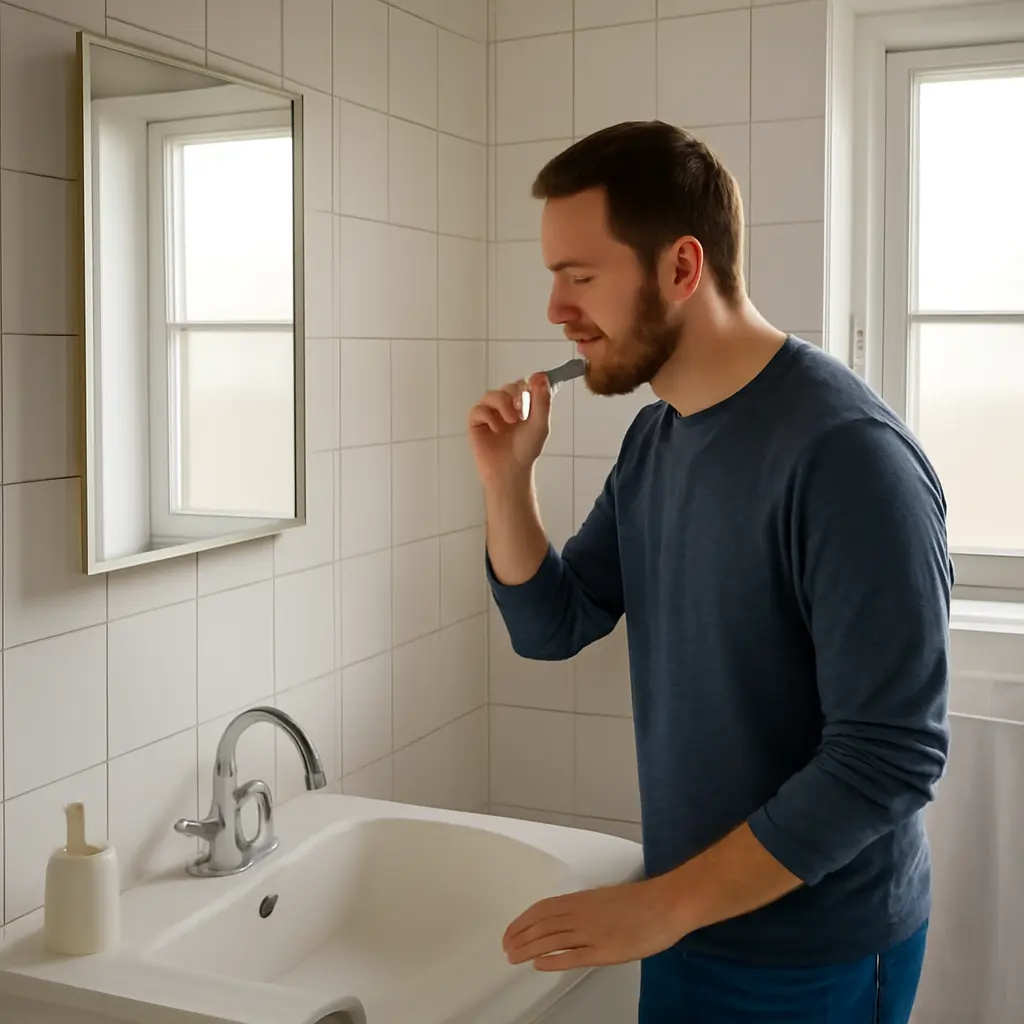
At-home whitening safety monitoring is the practice of checking for tooth sensitivity and gum irritation during bleaching and using those symptoms—not a desire for faster results—to decide whether to continue, pause, or ask a dental professional before changing the schedule. The American Dental Association (ADA) identifies tooth sensitivity and gingival irritation as common, usually temporary side effects of peroxide whitening. There is no universally validated sensitivity score that makes increasing treatment frequency safe: follow the product label and, when treatment is dentist-supervised, the dentist’s instructions. A practical threshold is to avoid increasing frequency while symptoms are present, worsening, or lingering between applications; stop and seek dental advice for significant, persistent, or unusual pain. The sections below explain symptom thresholds, product and schedule differences, monitoring methods, and when to seek care.
Whitening safety monitoring and sensitivity thresholds
Tooth whitening uses bleaching agents—most commonly hydrogen peroxide or carbamide peroxide—to lighten natural tooth color. The ADA describes sensitivity and soft-tissue irritation as the most frequently reported adverse effects of vital-tooth bleaching. Their likelihood and severity vary with the product’s concentration, exposure time, application method, existing dental conditions, and individual response. Monitoring is therefore a way to recognize a possible adverse effect, not a substitute for diagnosis or a guarantee that treatment is safe.
A clinically useful “threshold” is an action point rather than a single number. Dental research and consumer guidance do not establish one symptom score that applies across strips, trays, gels, and whitening toothpastes. In general, mild, brief sensitivity that resolves after an application warrants caution and continued observation—not automatic escalation. Sensitivity that is increasing, continues between applications, disrupts eating or drinking, or accompanies gum injury is a reason not to increase frequency and to follow the label’s stop instructions or contact a dentist.
What sensitivity can mean
Whitening-related sensitivity often feels like a short, sharp response to cold, air, or touch. It may occur because peroxide reaches the tooth through enamel and dentin and temporarily affects the tooth’s internal tissues. However, pain can also arise from cavities, cracks, exposed roots, leaking fillings, or gum disease. New, localized, spontaneous, or lingering pain should not simply be assumed to be a normal whitening reaction.
A 2018 review in the Journal of Evidence-Based Dental Practice by Carey describes tooth sensitivity and gingival irritation as common adverse effects of peroxide bleaching and notes that effects are generally transient. That general pattern does not establish that persistent symptoms are harmless. The ADA likewise advises consumers to consult a dentist if sensitivity or irritation becomes troublesome.
A practical symptom-based action framework
Use the following framework as a cautious monitoring aid, not as a validated clinical scale. Product directions and a treating dentist’s advice take precedence.
- No symptoms: Continue only as directed on the product label or by the dentist. Do not exceed the stated wear time or daily frequency, and do not assume that using more often will improve safety or results.
- Mild, brief sensitivity that fully settles: Do not increase frequency while monitoring the response. If the product instructions allow, consider a pause or less frequent use; ask a dentist or pharmacist about appropriate sensitivity-management options, especially if you have a history of dental problems.
- Worsening sensitivity, symptoms between sessions, or pain affecting normal eating and drinking: Stop whitening and contact a dentist before restarting or changing the schedule. A dental assessment can help distinguish a temporary treatment effect from an underlying problem.
- Severe or persistent pain, visible gum injury, swelling, or symptoms that concern you: Stop the product and seek prompt dental advice. Facial swelling, difficulty swallowing or breathing, or a serious allergic-type reaction requires urgent medical care.
A simple symptom log can make these decisions clearer: record the product, application time, duration, sensitivity intensity, triggers, gum changes, and how long symptoms last. A 0-to-10 rating may help describe a trend to a clinician, but it is not an established universal threshold for increasing treatment frequency.
Product type and schedule change the risk picture
Whitening products are not interchangeable. Their active ingredient, concentration, contact time, fit, and instructions affect exposure. The ADA notes that both professionally supervised and over-the-counter approaches are used, but correct use matters; a product’s availability does not mean it is suitable for every person or every tooth condition. Before changing frequency, identify the exact product and follow its own directions rather than borrowing a schedule from another format.
Whitening strips and paint-on products
Over-the-counter strips and gels deliver peroxide directly to tooth surfaces for a specified period. Follow the package’s wear time and frequency exactly, and keep gel off the gums when the instructions call for careful placement. Extending wear time, doubling applications, or using multiple peroxide products together can increase exposure and irritation without establishing a safer or more effective regimen. If sensitivity begins, do not add sessions to compensate for a missed application.
Custom or dentist-dispensed trays
Tray whitening uses a bleaching gel held against teeth. A well-fitting tray can help limit gel contact with gums, while excess gel or a poor fit may contribute to irritation. Concentration and wear time differ among products, so a schedule prescribed for one gel should not be applied to another. If symptoms develop, contact the supervising dentist for instructions rather than independently increasing, extending, or restarting treatment.
Whitening toothpaste and other products
Many whitening toothpastes mainly remove surface stains through abrasives; some products also contain chemical whitening ingredients. They are not equivalent to peroxide strips or tray gels in exposure or effect. Avoid combining products simply because each is sold over the counter. The ADA advises following product directions and discussing whitening with a dentist, especially when oral health concerns are present.
Monitoring before considering any frequency change
A frequency change should be considered only within the product’s permitted instructions or after a clinician’s advice. Before a planned change, check for symptoms, inspect the gums for irritation, confirm the product and expiry information, and review the label’s maximum use. If you have sensitivity, gum irritation, or uncertainty about an existing dental condition, postpone escalation and obtain professional guidance.
Check oral health and restorations first
Whitening does not treat decay, gum disease, or damaged teeth, and it does not change the color of crowns, veneers, fillings, or other restorations in the same way as natural enamel. The ADA recommends consulting a dentist before whitening because an examination can identify conditions that may need treatment first and help set realistic expectations. Uneven color after whitening may reflect restorations or intrinsic discoloration rather than a need for more frequent applications.
Track timing, triggers, and gum response
Record whether sensitivity occurs during application, immediately afterward, or later; whether it affects one tooth or several; and whether cold, heat, sweet foods, or brushing trigger it. Note any gum whitening, redness, tenderness, or sores where product contacted tissue. This context can help a dentist assess whether the pattern fits a temporary bleaching reaction or needs investigation.
A chart can make the decision process easy to review: list each treatment date alongside sensitivity before treatment, peak intensity, time to resolution, and gum symptoms. A steady rise in symptoms or incomplete recovery between sessions is a reason to pause—not a signal to tolerate discomfort in pursuit of faster whitening.
Avoid unsafe “catch-up” dosing
Do not double a session after missing one, exceed label frequency, leave a product on longer than directed, or combine bleaching products unless a dentist has specifically advised it. The National Health Service (NHS) notes that teeth whitening is not suitable for everyone and that dental assessment is important; it also cautions against treatments from unqualified providers. Although that guidance addresses whitening broadly, the same safety principle applies at home: use an appropriate product as directed and seek qualified advice when symptoms or suitability are uncertain.
When to pause, contact a dentist, or seek urgent care
Pause whitening when symptoms are more than mild and short-lived, are worsening, persist between applications, or involve gum injury. Contact a dentist before restarting if pain is localized, spontaneous, lingering, or associated with a visibly damaged tooth or restoration. Seek urgent care for facial swelling, difficulty breathing or swallowing, or a rapidly worsening reaction. These signs are not routine whitening sensitivity.
The ADA’s consumer guidance emphasizes that whitening can cause temporary sensitivity and gum irritation and recommends dental consultation when problems occur. A dentist can check for decay, cracks, recession, or other causes and advise whether to stop, change products, or use a different schedule. Do not use pain relief to mask symptoms so you can continue or intensify whitening without professional advice.
Conclusion: monitor symptoms before changing whitening frequency
At-home whitening safety monitoring depends on symptom pattern, product directions, and individual oral health—not on a single validated sensitivity number. Mild, brief sensitivity may be temporary, but worsening pain, symptoms that continue between applications, impaired eating or drinking, and gum injury are reasons not to increase frequency. Use only the product’s stated schedule, keep a brief symptom log, and consult a dentist before restarting after significant or persistent symptoms. For personalized advice, arrange a dental assessment before whitening if you have untreated dental concerns, restorations, or a history of sensitivity.
Sources: American Dental Association, Whitening, https://www.ada.org/resources/ada-library/oral-health-topics/whitening; Carey CM, Tooth Whitening: What We Now Know, Journal of Evidence-Based Dental Practice, 2018, https://doi.org/10.1016/j.jebdp.2018.02.006; National Health Service, Teeth whitening, https://www.nhs.uk/conditions/teeth-whitening/